

How to define Social Media goals
Setting social media goals is akin to looking at the top of the mountain and saying, “I will get there!” It is well known that…

Redação Swonkie
Equipa editorial
“I got 150 likes on my post” Hmmm… ok! So what? Is that good or bad? Without benchmarking your social media, this is exactly what…
By Redação Swonkie
Equipa editorial
2023-07-20 · 6 min read
“I got 150 likes on my post”
Hmmm… ok! So what? Is that good or bad?
Without benchmarking your social media, this is exactly what happens. You look at a number without any kind of context, and you can’t draw any conclusions.
In this article, we’ll put an end to this and other doubts on the topic of social media benchmarking.
But first, here is your navigation menu:
This “complicated” term can be explained with one sentence:
“It is the process of comparing a company’s processes and performance indicators, with the best companies and practices in the industry”
The key word in the definition is process. It is not enough just to make a superficial analysis.
Quite the opposite.
Whatever area you want to benchmark, you should follow this model of thinking:
What are my competitors doing?What is my company doing?Based on that, what can I improve?
If you are wondering what to do if your company has no direct competitor, then the answer is “compare yourself with companies that inspire you”.
Before we go any further, it is important to mention that you can also benchmark internally. That is, when instead of comparing your results with those of your competitors, you compare them with your past results.
Internal benchmarking is important to understand your individual growth. However, do not get carried away by these results alone, as they may be good in comparison to the company’s internal parameters, but in general, they may be mediocre or bad.
Now that you know what a benchmark is, let’s move on to the next question:
The answer is yes!
Without a benchmark on your social media, it’s like driving a car blindfolded.
You know you’re driving, you know you have to accelerate, but you have no idea if you’re going to crash, or if you’re on the right road.
In terms of social media, you know you’re creating content, you know you have to keep going, but you have no idea if it’s the right strategy, or if you need to change it.
And to prevent that from happening, you need to benchmark your social media, ideally every 3 months.
Some of the benefits of doing a benchmark on a regular basis are:
The first step to benchmarking is to define exactly what you want to analyze and why you need to analyze it.
Do you want to analyze your average interaction rate on content for the month of January? If yes, why? To understand the drop compared to the Christmas peak season?
In addition to this, you should think about which social media channels you are going to analyze.
As there are more than a dozen social networks where a brand can be present, it is important to taper the number of networks analyzed according to the company’s objective.
This step is where you will list exactly which competitors you will compare yourself to.
If you don’t have direct competitors, as mentioned above, choose companies that inspire you, and that are as comparable as possible to the area you want to analyze.
However, we would like to point out that sometimes, even if you do have direct competitors, it can be useful to see what other industry-leading companies are doing on social media.
You may not be a direct competitor of McDonald’s but you may want to analyze how the brand communicates on social media, what hashtag strategies it uses, what frequency of posts they have, and among other things.
With your goals set and competitors chosen, it’s time to move on to the next stage:
Enough theory. Let’s get to the action.
This is where you can collect your quantitative and qualitative data.
You can choose to collect this data manually (good luck) or use Swonkie, a social media management platform, to do it in no time, and automatically.
To create a benchmark report in Swonkie, follow these steps:
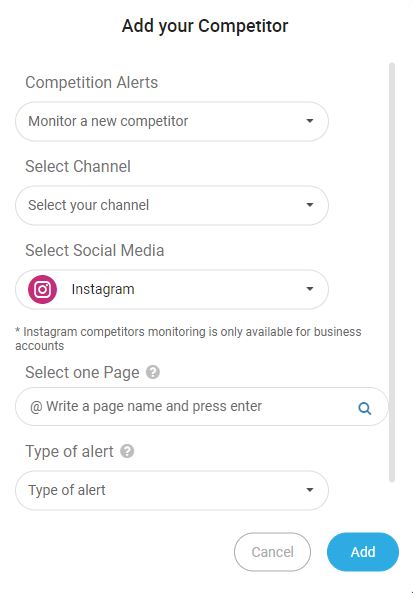
Then this menu will appear, where you can fill in the form you see in the image above.
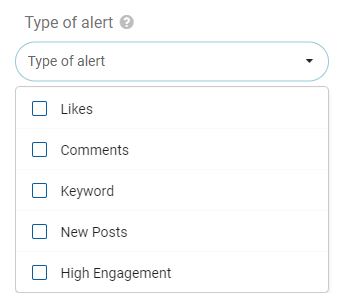
In the type of alert you will be able to configure different types that you want to receive:
When you finish setting up the form, you will be redirected to a personalized feed that will allow you to exclusively monitor and analyze your competitors’ publications in real-time.

It’s time to create a comparison report between your social media page and your competitors’.
See which ones in the image below:
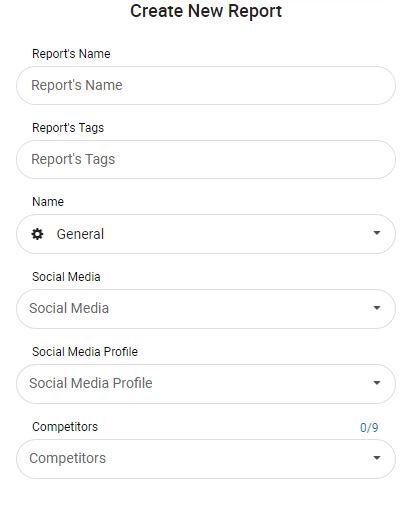
Once you’ve filled in this data, you’ll have your report available with dozens of graphs and metrics, so you can compare exactly how your social media performance is doing against the competition.
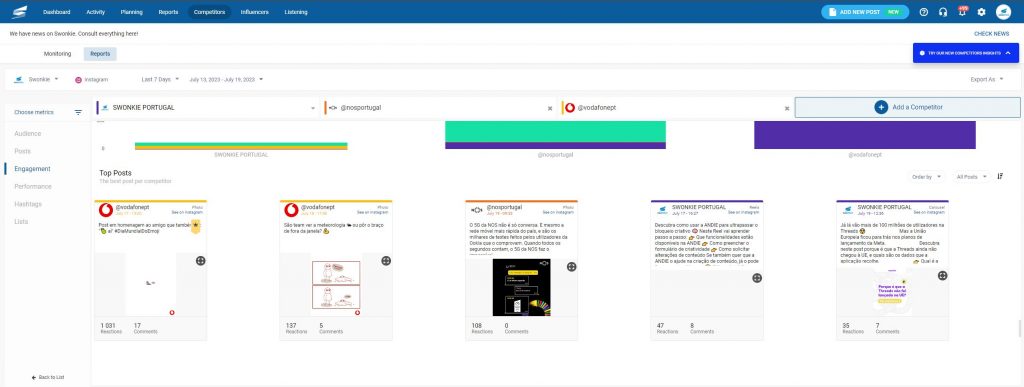
In Swonkie’s competitor reports, you can compare your audience, posts, interaction, performance, hashtags, and even a list of top posts.
If you also want to create your report for free for 14 days, click here.
Now with the data available for analysis, it’s time to gather your strengths and weaknesses and move on to the next step:
It is time to interpret all the data you have collected and develop an action plan.
It is important to identify which changes can be made immediately, and those that need more resources.
Also, make sure your plan is realistic and adapted to the resources your company has.
To help you with this part, you can separate the improvements that need to be made into 2 “categories”: those that can be implemented immediately, and those that need more resources.
Once you have identified which category these changes fall into, implement the ones that can be changed immediately first, and then focus on the ones that are more costly in terms of resources and time.
The frequency will depend on the size of your company and social media.
If you are a micro/small business, with little social media presence, and no dedicated social media manager, then a benchmark every 6 months should be sufficient.
If you are a company with a more active social media presence, and with one or more professionals dedicated to social media management, then you should do it at least every 3 months, and every month may also be advisable.
For reference, at Swonkie we do an internal and external benchmark every month, where we analyze our performance on the various social media channels where we are present.
It won’t do you any good to benchmark your social media, develop an action plan and implement the changes if you don’t measure your results afterward.
Consistency is the key factor when it comes to benchmarking.
To keep an eye on your results – and those of your competitors – you can use Swonkie.
If you don’t have an account yet, you can try it for free for 14 days.

Setting social media goals is akin to looking at the top of the mountain and saying, “I will get there!” It is well known that…
Redação Swonkie
Equipa editorial

When you talk about SWOT analysis, sirens go off. Just like SWAT, SWOT analysis polices the internal and external environment of your social networks. This…
Redação Swonkie
Equipa editorial

On social media, it’s very easy to get distracted by the ” pink world” of content creation, engagement, and connecting with your audience. But managing…
Redação Swonkie
Equipa editorial